
BANDHANI: TRADITION TIED WITH EVERY KNOTS
Bandhani, also known as Bandhej, is one of Gujarat’s oldest traditional tie-and-dye textile arts. It is believed to have originated thousands of years ago as similar techniques found in ancient Indian textile traditions.
The main centres of Bandhani production in Gujarat are Kutch and Jamnagar. Skilled artisans create intricate patterns by tying thousands of tiny knots in the fabric before dyeing it. When the knots are carefully opened, they reveal beautiful dotted designs and distinctive patterns.
Traditionally, Bandhani is used for sarees, dupattas, turbans, and wedding garments. Today, it remains an important part of Gujarat’s cultural heritage and is admired worldwide for its vibrant colours, intricate craftsmanship, and artistic beauty.
CARE
Our products are handcrafted and handwoven or hand-block printed by skilled artisans. To ensure their longevity, dry cleaning is recommended for all our products.
- Avoid direct sunlight to prevent colour fading over time.
- For silk handwoven sarees, always dry clean and store them wrapped in a clean muslin cloth.
- Fold with acid-free tissue paper, if possible, to help protect the fabric during storage.
TANGALIYA SAREE – A LEGACY WOVEN IN EVERY THREAD
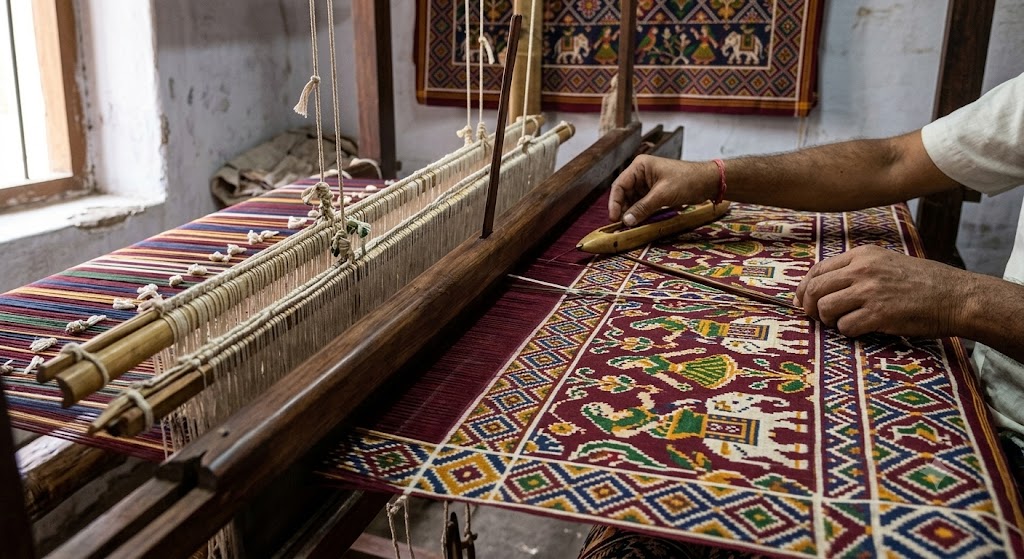
Discover the timeless beauty of Tangaliya, a centuries-old handweaving tradition from Gujarat, traditionally practised by the Dangasia community. Each saree is painstakingly woven by skilled artisans and distinguished by its unique raised, bead-like motifs, known as dana, created by skilfully twisting and inserting contrasting threads during the weaving process.
More than a saree, Tangaliya is a living textile heritage-an intricate art form shaped by generations of knowledge, patience and craftsmanship. Each piece carries the individuality of the artisan and reflects a weaving tradition that has been carefully passed down through generations.
By choosing a Tangaliya saree, you not only wear a distinctive piece of Gujarat’s textile heritage but also support artisan families and contribute to the preservation of one of India’s rare and remarkable handweaving traditions.
INDUS ETHNICS
Inspired by the ancient Indus Civilization, renowned for its sophisticated textile traditions, rich cultural heritage, and exceptional craftsmanship, Indus Ethnics celebrates the enduring legacy of Indian ethnic textiles and handicrafts.
We believe clothing is more than fashion, it is a means of preserving culture, honouring craftsmanship, and celebrating the stories and traditions passed down through generation.
Founded by two friends, Alapa and Usha, who share a deep passion for Indian ethnic handicrafts, Indus Ethnics is dedicated to promoting the traditional crafts of the Indus region. Their vision is not only to bring authentic handcrafted products to a wider audience but also to support artisans and improve the livelihoods of skilled craftsmen and weaving communities.
Every piece we create reflects heritage, artistry, and timeless tradition. When you choose Indus Ethnics, you are not just purchasing a garment you are becoming a part of a journey to preserve centuries-old craftsmanship and empower the hands that keep these traditions alive.
TANGALIYA – THREADS OF LOVE, HERITAGE & CRAFTSMANSHIP
In the heart of Gujarat, the centuries-old art of Tangaliya weaving continues to tell a story woven with tradition, skill, and love. Practiced by the Dangasia community for over 700 years, Tangaliya is distinguished by its tiny bead-like dots, known as dana, intricately handwoven into the fabric and visible on both sides.
According to folklore, the craft began when a shepherd fell in love with a weaver’s daughter. To survive, the girl taught the boy the art of weaving, and together they created warm woolen garments for shepherd families. What began as a struggle for love, slowly became a tradition passed from one generation to another, giving birth to the Dangasia community and a beautiful art called Tangaliya weaving.
Today, every Tangaliya fabric represents not just exceptional craftsmanship but also the heritage, dedication, and an emotional love story descended through generations of artisans. By choosing Tangaliya products, you help preserve this rare art form, support weaving families, and encourage future generations to continue this remarkable tradition.
Every dot is a thread of love, every weave a piece of living heritage.
KALA COTTON – THE HERITAGE FABRIC OF THE FUTURE
Kala Cotton is an indigenous cotton variety of Kutch, naturally adapted to its harsh, dry climate and traditionally grown with rainwater, requiring little or no irrigation, chemical fertilisers, or pesticides. This makes it a natural, climate-resilient and sustainable fibre, while its cultivation preserves traditional farming knowledge and supports a resource-efficient approach to agriculture. Its short-staple fibres produce a strong, durable, breathable fabric that becomes softer with use, while its natural texture and earthy character give every piece a distinctive appeal.
Cotton cultivation in the Indian subcontinent dates back more than 4,000 years to the Indus Valley Civilisation; although a direct lineage to present-day Kala Cotton cannot be definitively established, it represents the enduring legacy of India’s indigenous cotton traditions. Pure Kutch Kala Cotton Handloom, woven by skilled artisans using traditional looms and weaving techniques, carries the character of the natural fibre along with generations of craftsmanship and cultural heritage.
As fashion increasingly moves towards natural fibres, conscious consumption and sustainable textiles, Kala Cotton is gaining renewed appreciation among consumers who value authenticity, environmental responsibility and traditional craftsmanship. Choosing Kala Cotton supports farmers and artisan communities while preserving indigenous knowledge and heritage. From rain-fed fields to handwoven fabric, Kala Cotton connects nature, culture and craftsmanship making it a time-tested textile for the sustainable fashion of tomorrow.
Care Instructions
Our products are handcrafted and handwoven or handblock printed by skilled artisans. Proper care helps preserve their natural character, colour, softness, and longevity.
- Dry clean or gently handwash separately in cold water using a mild liquid detergent.
- Do not soak for long periods.
- Avoid harsh detergents, bleach, and vigorous rubbing.
- Dry in the shade and avoid prolonged exposure to direct sunlight to help prevent colour fading.
- Store in a clean, dry place when not in use.
AJRAKH- BLOCK PRINT HERITGE
Ajrakh, also known as Ajrak, is a traditional hand-block printing craft associated with the cultural heritage of Sindh and Kutch. Recognised for its distinctive geometric symmetry, repeating motifs, and deep indigo, red, black, and earthy tones, Ajrakh reflects a remarkable combination of artistic precision, traditional knowledge, and cultural identity.
Ajrakh printing is a highly skilled, multi-stage process involving repeated washing, dyeing, resist printing, and hand-block printing. Traditionally, natural dyes such as indigo and madder-based reds are used, while carved wooden blocks create the characteristic geometric and floral patterns. The carefully balanced repetition of motifs, often arranged within a structured grid, gives Ajrakh its distinctive visual rhythm and depth.
Today, Ajrakh prints are available on a wide variety of fabrics, allowing this traditional craft to be adapted for contemporary clothing and lifestyle products. Depending on the intended use and design, Ajrakh may be found on cotton, modal silk, mushroom silk, Chanderi silk, and other fabrics. The choice of fabric influences the texture, drape, sheen, and overall character of the finished textile while retaining the distinctive visual identity of Ajrakh.
More than a decorative textile, Kutch Ajrakh represents a living heritage of traditional craftsmanship, preserving indigenous knowledge of natural dyes, resist techniques, wooden block carving, and textile production. Each hand-printed piece carries subtle variations that reflect the artisan’s skill and make the fabric unique. By sustaining artisan livelihoods and traditional production practices, Ajrakh continues to connect the rich textile heritage of the Indus region with contemporary clothing and design.